Showing posts with label parasite. Show all posts

Monday, August 3, 2020

How to eat parasites: a guide for the perplexed

Let's continue our cursed journey of learning all about parasites! Today we will learn how to eat parasites: what to eat, how to eat them, and what to avoid.

The main source I rely on is
Overstreet, Robin M., ‘Presidential Address: Flavor Buds and Other Delights’, Journal of Parasitology, 89.6 (2003), 1093–1107 <https://doi.org/10/dv2tdk>

Tapeworm diet

Kind of a meme really. The tapeworm diet idea is simple: if there's a tapeworm in your intestine, they would eat your food and get fat for you, so that you won't get fat.
Typical advertisement from early 20th century
While tapeworms usually do not make one sick, they can block the intestine if they get too big or too many, which is life-threatening. That, and they don't work that well for losing weight.

Also this delicious factoid:
The cysticerci of the pork tapeworm, Taenia solium, have been fed by unprincipled medical advisors to unwitting Hollywood actresses in the 1930s as "slimming pills," producing adults in the intestine (Russell-Hunter, 1979).

Friday, July 31, 2020

Rat King Parasite appreciation day

Ever heard of rat kings (Rattenkönig)? It is a real, rare, and disturbing occurrence.
A rat king is a collection of rats whose tails are intertwined and bound together by one of several possible mechanisms, such as entangling material like hair or sticky substances like sap or gum or getting tied together. Historically, this alleged phenomenon is particularly associated with Germany. There are several specimens preserved in museums but very few instances of rat kings have been observed in modern times.
Source
Such  "rosette" ("little rose") shapes of rats are called "rat kings", because the king of rats would sit on top of the knot in the center, being carried around on its throne like a king.

This phenomenon has been reported extensively, so I will not do it. Read this article if you are interested.

Wednesday, July 29, 2020

The placenta wars

The border zone or transition zone or “ Umlagerungszone” marks the division between the fetal and maternal tissues. As might be expected it is not a sharp line, for it is in truth the fighting line where the conflict between the maternal cells and the invading trophoderm takes place, and it is strewn with such of the dead on both sides as have not already been carried off the field or otherwise disposed of. In the earlier stages there is even more evidence of the deadly nature of the conflict than in the later stages.
Johnstone, R. W. (1914). Contribution to the Study of the Early Human Ovum, page 258.
The placenta appears to be a ruthless parasitic organ existing solely for the maintenance and protection of the fetus, perhaps too often to the disregard of the maternal organism. 
Ernest W. Page. (1939). The relation between hydatid moles, relative ischemia of the gravid uterus, and the placental origin of eclampsia
The placenta is simply a neuroendocrine parasite.
P. J. Lowry (2008). 

Today we take a long, hard look at the human placenta, find out how it is similar to a parasite, a tumor, and a battlefield between the mother and the fetus, and how this makes pregnancy much more risky than it could have been.

To start our journey, think about this question: why is pregnancy so dangerous? The reason is that, in a pregnancy, there are two bodies, instead of one, and they have different interests. They cooperate, but they also fight each other.

The fetus is selfish: it wants itself to be strong. The mother is also selfish: it would rather not devote too much energy to the fetus, because if it does, it would not have enough energy to make another fetus. This is the secret war, taking place on the placenta.

Unless otherwise noted, I'm generally referring to Haig, David, ‘Genetic Conflicts in Human Pregnancy’, (1993).

The ignored placenta  

The placenta... the place where the embryo meets the mother, where the embryo receives the nutrients and the mother receives the waste products. It is a vital organ, but rarely given a thought at all. Think about all the vital organs: brain, heart, lung, stomach, guts, liver, skin, muscles, bones, hand, arm, feet, leg, ovary... each having its own rich implications in culture.

  • "Screaming at the top of the lungs"
  • "Brain of the team"
  • "Right to bear arms"
  • "Got guts"
  • "Don't drink too much or your liver would complain"
  • ...

But what about the ignored organs? The pancreas is all but forgotten, and we can't really blame that. It's small, and has been dismissed as merely a meaty cushion until about 19th century. Even now, its only claim to fame is that it makes insulin, which keeps us from becoming diabetic.

Tuesday, July 28, 2020

Genitalia, sperm, sex: evolutionary divergence.

Sometimes a good idea just keeps getting rediscovered. The eye has evolved many times independently, and parasitism has evolved for no less than 60 times. This is called convergent evolution. And of course, it has its evil twin... divergent evolution.


Consider this picture below, of the complex shapes of closely related species of Bombus (bumblebees). These species are so similar that the main way to distinguish them is by looking at their penises...
Source: The Evolution of Primary Sexual Characters in Animals, Figure 4.1

Let's read: Parasite of the Day, Part 3


https://dailyparasite.blogspot.com/2020/04/armillifer-armillatus.html
For a multistage parasite, it usually treats its final host well, but the intermediate host unwell. Here, a cheetah ate a snake and got infested by parasites that mistook it for an intermediate host. This resulted in severe infestation.
A male leopard at Kruger National Park, South Africa, which became heavily infected with tongue worm Armillifer armillatus. Researchers found hundreds of A. armillatus larvae throughout the leopard's body cavity, encysted or crawling through the liver, spleen, intestine, and lungs. 
the leopard might have eaten snakes which were infected with female tongue worms that were full of fertilised eggs. After the eggs were liberated from the adult tongue worm's body, they hatched and enter into the next stage of development - the nymphs.

Let's read: Parasite of the Day, Part 2


Hyperparasites, illustrated by gambling

Consider a gamble house. The ones running the gamble house are parasites upon the gamble addicts.

The moderate gamblers, those who gamble for a little fun, arguably derive more pleasure from the gambling experience than pain of losing money, so the gambling house and the moderate gamblers are mutualistic.

The professional gamblers, the card counters, those who can earn money from the gamble house, are the hyperparasites on the gambling house.

Then there are those hired by the gambling house to catch the card counters. Those are the hyperhyperparasites.

Thus we obtain an ecosystem with:

  • Gamble addicts: the hosts.
  • Gamble houses: the parasites
  • Moderate gamblers: creatures that are mutualistic with the parasites.
  • Professional gamblers: the hyperparasites.
  • People hired to catch the professional gamblers: the hyperhyperparasites.

Sunday, July 26, 2020

Let's read: Parasite of the Day, Part 1

Parasite of the Day is a blog all about parasites! It's amazing, but also really really long. This post is my digest of that blog.

Eyescream

The zombie fungus ants often go out to die at a fixed place. This place would be full of ants, and called "ant graveyard".
Graveyards on the Move: The Spatio-Temporal Distribution of Dead Ophiocordyceps-Infected Ants. PLOS ONE 4, e4835 (2009).

I'm a parasite! Who are you? Wait, am I?

I'm a Parasite! Who are you?
Are you – Parasite – too?
Then there's a pair of us!
I don't know how to continue this poem.
-- not really Emily Dickinson

While I'm studying about parasitism, I recognized that humans have parasitic castrators too. There are many belief systems (memeplexes) that can castrate humans: it stops people from reproducing somehow. Perhaps the most famous example is Theravada Buddhism, and to a lesser extent, Mahayana Buddhism. 

Theravada Buddhism is a parasitic castrator

In Theravada Buddhism, the main way to escape this painful world is to give up attachment to this world, become a monk, and perform various mental exercises like studying and meditation. Mahayana Buddhism is less strict, and gives more hope for non-monks to also escape, but the monks must still remain celibate.

In biology, parasitic castrators are parasites that stop the hosts' reproduction, completely or in part, to its own benefit. 

Now match that to Theravada Buddhism:
  • Theravada Buddhism (TB) stops the host from reproducing, by directing the host into a monastic lifestyle.
  • The celibacy of the host directly benefits the reproduction of TB, since a celibate host has more time to devote to the duties, such as copying the sutras (part of the memetic code of TB), perform Buddhist rituals like chanting (increasing the social influence of TB), teaching Buddhism to the next generation (TB reproduction), etc.
We see that it is a memetic parasitic castrator, hosted on Homo sapiens, regarded as a genetic creature.

Let's Read: Parasite Rex

Let's read through Parasite Rex (2001), chapter by chapter.

Prologue


Parasites are much more prevalent and important than people give credit for. A majority of species of multicelluar life are parasites.

The biodiversity of parasites is astonishing and there is so much to learn, especially since biologists have long considered parasites as a freakish side-show to the spectacle of life.

Chap 1. Early history of parasitology.

Caduceus is probably based on the primitive therapy for guinea worm.

Renaissance doctors think that parasites are internally generated tissues/spontaneously generated organisms, symptoms, not causes, of diseases.

Spontaneous generation is falling out of favor in the 18th century thanks to experiments on rotten meat (disproving spontaneous generation of maggots) and meat soup experiment of Pasteur (disproving spontaneous generation of microorganisms).

Parasites posed theological problems:

1. If parasites are truly spontaneously generated, then it'd be accrediting bodies with the power to create life, which is playing God.

2. Theodicy. Darwin's quote about parasitoid is relevant:
I cannot persuade myself that a beneficent and omnipotent God would have designedly created the Ichneumonidae with the express intention of their feeding within the living bodies of caterpillars...
The familiar animals (fish, cats, humans...) have their young looking very similar to their adults. This is not so for parasites. Most of them have complex life-histories, with vastly different body shapes. Japetus Steenstrup was the first to propose that they travelled from host to host, changing their body shapes as they do.

Friedrich Küchenmeister proposed that bladder worms (little worm hiding in cysts in animal muscles) would develop into tapeworms in the digestive tract after being swallowed (usually when the host is eaten).

In 1854, then 1859, he proved his theory by feeding death row inmates with bladder worms (hidden in food), then dissecting the corpses and finding developed tapeworms.

What does it feel like to be a parasite?

Today's post is based on Sukhdeo, Michael, ‘Earth’s Third Environment: The Worm’s Eye View’, BioScience, 47.3 (1997), 141–49 <https://doi.org/10/c8m7zv>

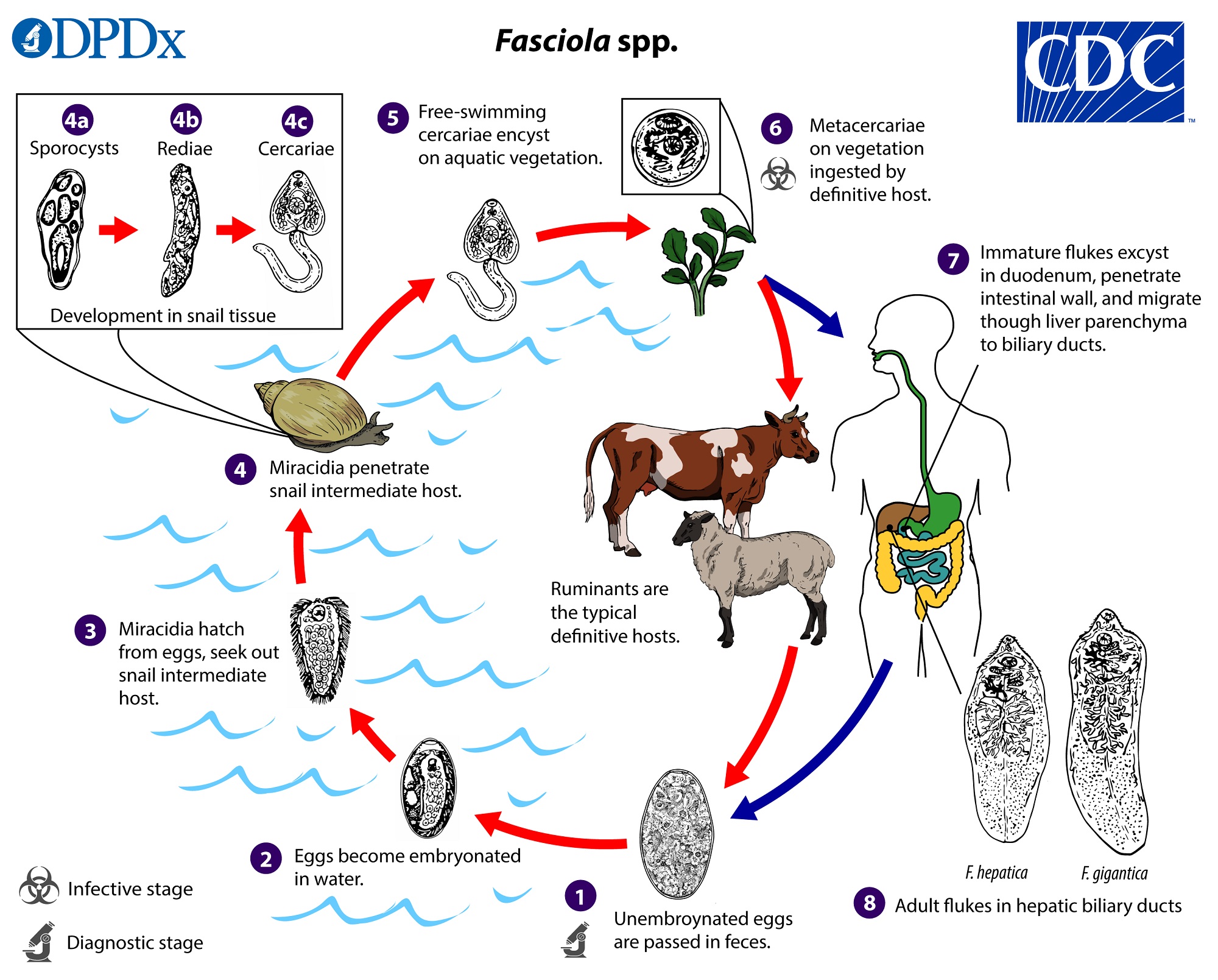
You know liver flukes? Those leaf-shaped worms that can infect your liver if you drink bad water or eat undercooked freshwater fish?
Source: Wikipedia
Fasciola_LifeCycle_lg.jpg (2000×1609)
Source: CDC

Those creatures have a pretty complex lifecycle to exploit two kinds of hosts, as shown above. 
  1. Eggs hatch in water into "miracidia". Miracidia are little swimmers.
  2. Miracidia find a snail and somehow get into the snail. The two popular methods are being eaten, and tunneling through the skin of snail.
  3. Miracidia develops into sporocysts. Sporocysts are basically egg bags.
  4. Little eggs in sporocysts develop into rediae. Rediae are basically hungry hungry little worms. They not only eat food from the snail's body, but eat other parasites too, to reduce the competition.
  5. Rediae give birth to cercariae, which look like tadpoles. They get out of the snail somehow (by pooping or by tunneling through), and swim to the shore.
  6. Cercariae climbs onto a plant and builds a hard, waterproof shell called a metacercariae. It hibernates there until it's eaten, usually by a cow or sheep.
  7. The metacercariae bursts out of the shell, tunnels through the digestive tract, and somehow finds the liver. At this stage, they are called "flukes", and they can cause all kinds of nasty diseases.
  8. The flukes grow up and have sex in the bile duct, then the female flukes lay eggs in the river of bile. The eggs would be washed into the intestine, then pooped out, starting the cycle again.

Saturday, July 25, 2020

Parasites are everywhere, EVERYWHERE

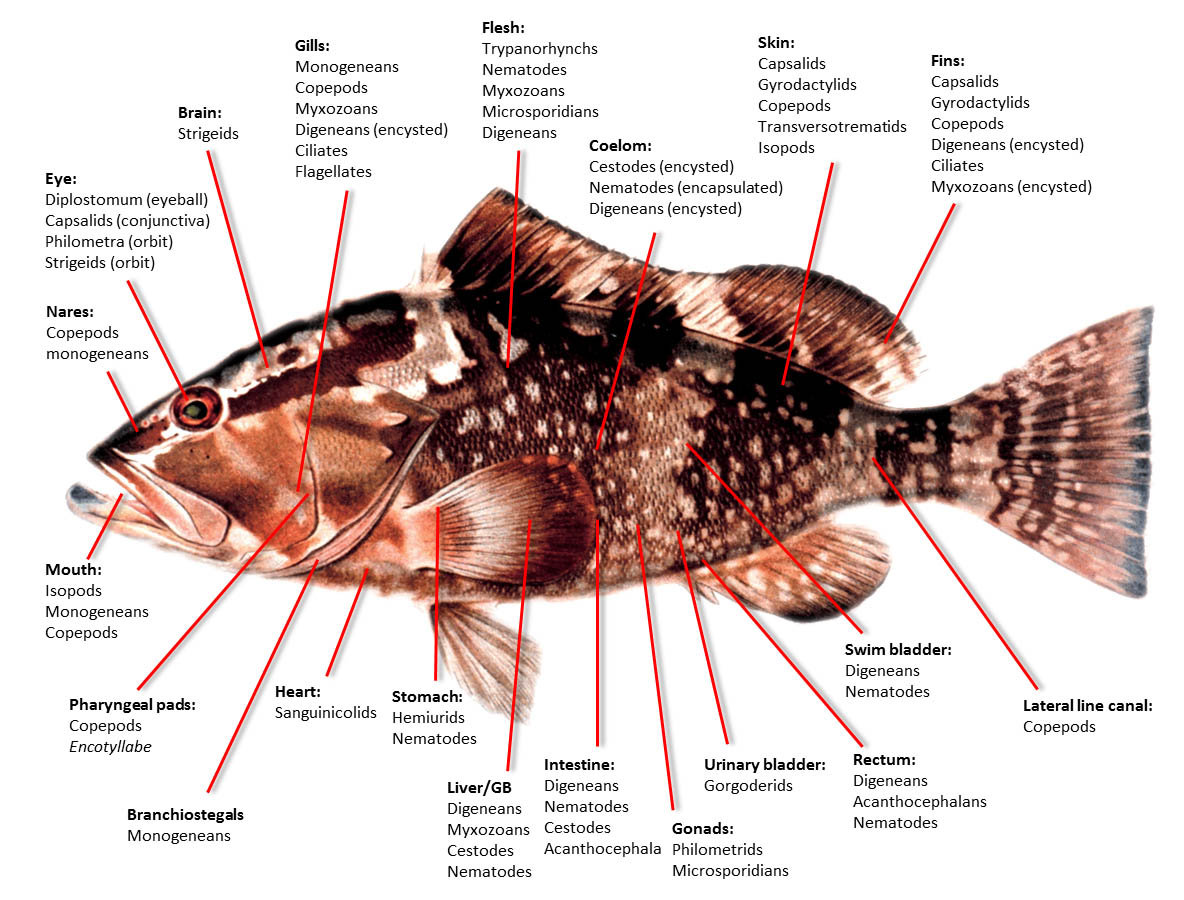
Let's start with a handy graphic showing you how absolutely infested a typical fish is with parasites.

A guide to parasites on a typical fish
your average fish is, to parasites, a diverse palette of microhabitats, all of which are ripe for the exploiting for the cost of a few specialized adaptations.  If you look hard enough, you’ll find something living in most of these microhabitats, in most species of fishes. -- Alistar Dove
And the thing is, in typical, healthy, functional ecologies, parasites are EVERYWHERE. Such infestation is not usually a sign of ecological poor health.

Friday, July 24, 2020

Extremely biased sex ratios: the case of sibling-incestuous parasitoid wasps

In 1930, Fisher argued that, in a species that must reproduce sexually, has exactly two sexes, and with perfectly random mating (every female-male pair chosen randomly, until no more female-male pair can be made, and each chosen pair mates, producing offsprings), the optimal sex ratio is 1:1 for the selfish genes.

The argument is very simple: Suppose that, right now, the sex ratio is 
female:male = A:B
and A > B. Then by random mating, every male would be paired off and have offsprings, but some females would be unlucky and have no offsprings. Then, every gene has a selfish interest in avoiding falling into a female offspring, which might end up a genetic dead-end. As such, genes that nudge the offspring sex-ratio to make more males would be adaptive and spread through the population, decreasing the female:male ratio.

Similarly if there are more males than females. Thus, the equilibrium sex ratio is 1:1.

This argument can be made rigorous with more algebra, but the gist is there.

However, this result can be grossly wrong when mating is very much not random, which is the case in many species with extensive sib-mating (blood sibling incest). This was pointed out by Extraordinary sex ratios, (Hamilton, 1967). 

The argument is pretty simple. Consider parasitoid wasps. Those are basically the real life equivalent of Alien xenomorphs: the mother wasps lay eggs inside a living caterpillar, and the young wasp larvas eat the caterpillar as they grow up. 

In many parasitoid wasps, the caterpillar is usually their only meal in life. The male wasps would crawl out and immediately mate with the females and then die. The female wasps would fly out and search for new victims.

Since each caterpillar is usually victimized by just one or a few mother wasps, once the caterpillar dies and the wasps crawl out to mate, a lot of the matings would be sib-matings. This breaks the random mating assumption, and causes a sex-ratio biased to have a lot of females.

The reason goes like this: Consider the extreme case of only one wasp parasitizing a caterpillar. All the offsprings would then be from one mother. In such cases, sex isn't useful, since all the benefits of sexual reproduction (genetic recombination giving innovations) are gone. In such cases, the mother might as well clone itself and have an all-female brood. 

This extreme case is tempered to only a very high female-to-male ratio in the case of a few mothers parasitizing a single caterpillar.

Let's Read: Neuropath (Bakker, 2009)

Neuropath  (Bakker 2009) is a dramatic demonstration of the eliminative materialism worldview of the author R. Scott Bakker. It's very b...